
Marsh Fishing Gear: Your Complete Equipment Guide
By Bobby Harris — Navy FMF Corpsman (2002–2010), founder of First Rise Outfitters
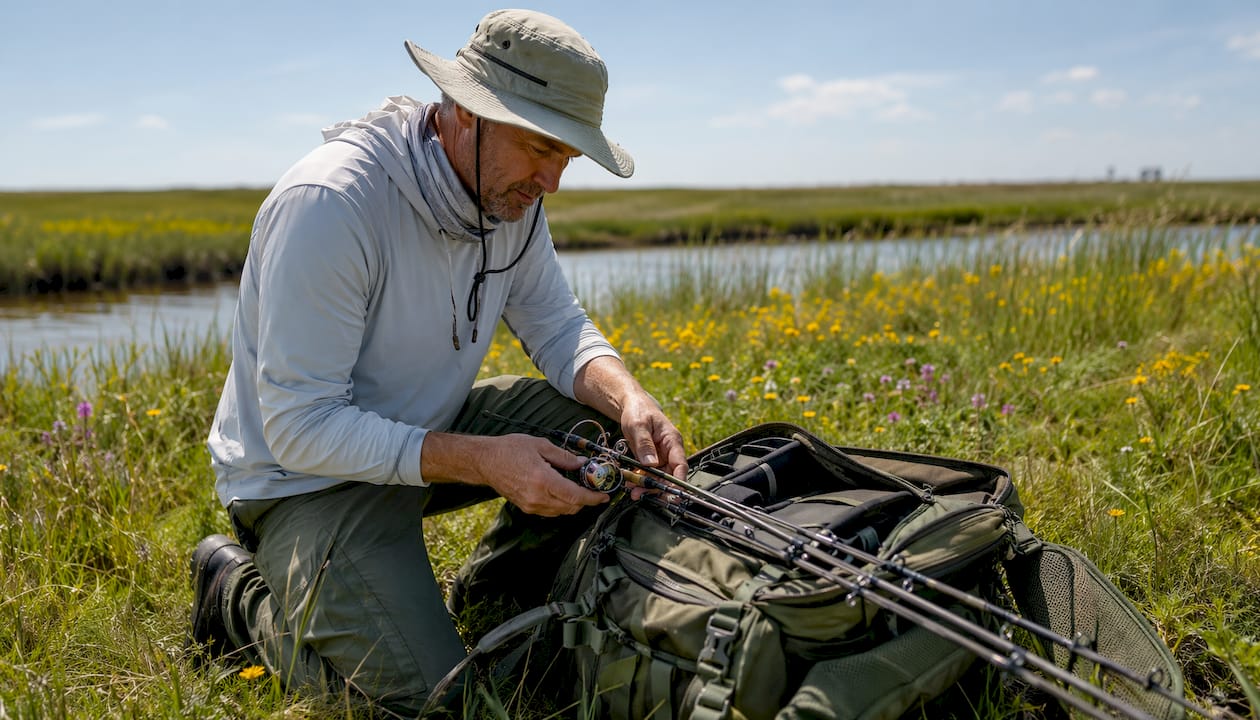
Marsh fishing gear is purpose-built fishing equipment engineered to endure corrosive saltwater, abrasive mud, and razor-sharp oyster beds while keeping you effective and responsible on the water. Salt marsh environments are unforgiving. The combination of tidal fluctuation, pluff mud, and saline exposure destroys standard freshwater tackle faster than most anglers expect. Getting the right wetland fishing equipment before your first wade is not optional. This guide covers every gear category you need, from corrosion-resistant reels to sustainable landing nets, so you can fish confidently and protect the marsh at the same time.
What are the essential types of marsh fishing gear?
The right marsh fishing gear starts with a corrosion-resistant reel. Salt marshes act like liquid sandpaper on standard tackle, and sealed drag systems are the first line of defense. Experts recommend spinning reels sized 2500–3000 with 5+1 stainless steel ball bearings. That bearing count keeps the retrieve smooth even after repeated saltwater exposure.
Your rod matters just as much as your reel. Aluminum oxide or black-finish guides resist the pitting that standard chrome guides develop after a single season in the marsh. Pair a medium-heavy 7-foot rod with your saltwater reel and you have a setup that handles redfish, speckled trout, and flounder without flexing on the hookset.
Line selection separates anglers who land fish from those who lose them to oyster edges. Fluorocarbon leaders with 20–30 lb strength provide near-invisibility and abrasion resistance that wary marsh gamefish demand. The hard outer shell of fluorocarbon resists cutting on barnacle-covered structure, while the flexible core maintains knot strength under pressure.
Wading boots deserve serious attention. Boots built for oyster flats use thick rubber soles with aggressive tread to grip slick shell beds. Neoprene uppers protect your ankles from cuts while giving enough flex to pull your foot free from soft mud. Never wade a salt marsh in standard sneakers or thin-soled sandals.

Waterproof packs protect your electronics and tackle during deep crossings. IPX7-rated packs with TRU Zip or TIZIP closures stay fully submersible and keep your phone, keys, and spare tackle dry. A standard 15-liter capacity balances mobility with enough room for a full day’s kit.
Pro Tip: Carry corrosion-resistant pliers with a lanyard clip. Saltwater pliers made from titanium or anodized aluminum will not seize up mid-trip, and a lanyard keeps them from sinking into the mud if you drop them.
| Gear Category | Key Feature | Why It Matters |
|---|---|---|
| Spinning reel | Sealed drag, 5+1 SS bearings | Resists salt corrosion and component seizure |
| Rod guides | Aluminum oxide or black-finish | Prevents pitting from abrasive saltwater |
| Fluorocarbon leader | 20–30 lb, hard outer shell | Abrasion resistance near oyster structure |
| Wading boots | Thick rubber sole, neoprene upper | Grip on oyster beds, ankle protection |
| Waterproof pack | IPX7-rated, TRU Zip or TIZIP | Keeps electronics dry during deep crossings |
| Landing net | Floating, knotless, rubber-coated | Protects fish slime coat, prevents snagging |
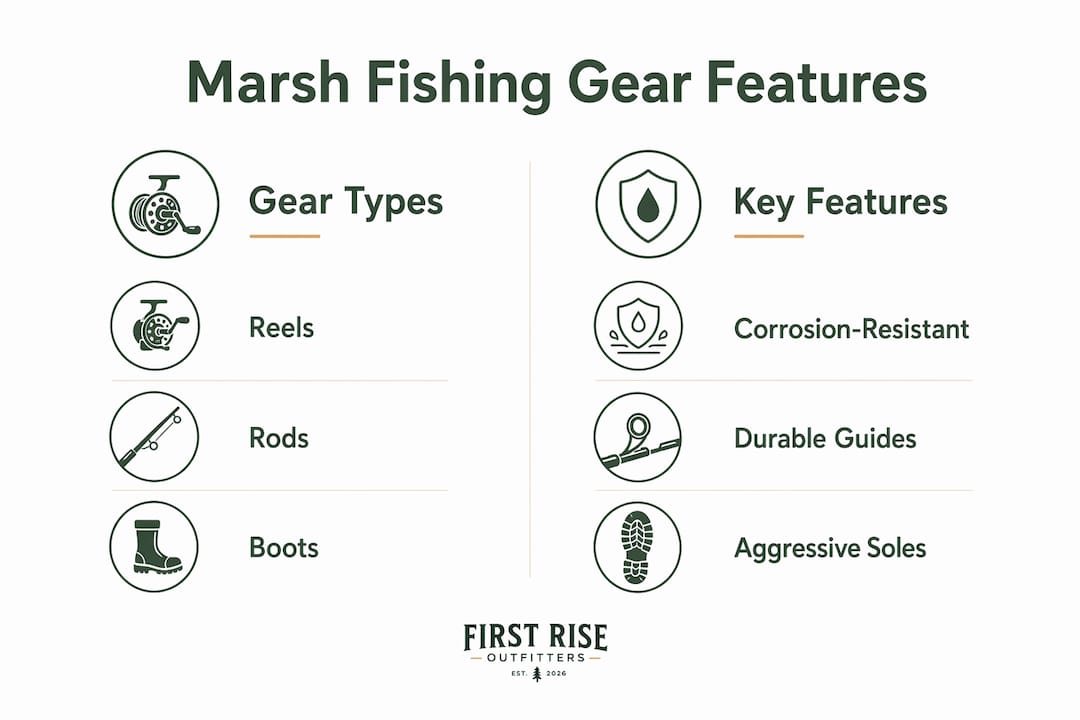
Floating, knotless, rubber-coated landing nets prevent snagging on oyster reefs and protect the slime coat of fish during catch-and-release. A 24-inch hoop handles slot-sized redfish without bending or folding. The rubber coating also makes it far easier to remove hooks cleanly.
How to properly maintain and clean marsh fishing gear
Post-trip maintenance is the single biggest factor in how long your gear lasts. Rinsing with gentle fresh water immediately after use stops salt crystals from forming inside bearings and seals. Skip the rinse once and you accelerate corrosion by days. Skip it consistently and you will be replacing reels every season.
Follow this maintenance routine after every marsh trip:
- Rinse your reel with low-pressure fresh water. Never use a pressure washer. High-pressure water forces salt deeper into the drag system and bearing races.
- Wipe down your rod blank and guides with a damp cloth. Pay extra attention to the guide feet where salt collects under the wrapping.
- Rinse your wading boots inside and out. Mud trapped inside the boot holds moisture against the neoprene and accelerates breakdown.
- Dry all gear in a shaded, ventilated space. Direct UV exposure degrades neoprene, rubber coatings, and line faster than saltwater does.
- Apply a marine-grade reel oil to the bail arm pivot and line roller after drying. One drop is enough. Over-oiling attracts grit.
- Lubricate plier joints with a corrosion-inhibiting spray like Boeshield T-9 or WD-40 Specialist Corrosion Inhibitor. Both are widely available and safe for metal fishing tools.
- Store reels in a breathable cloth bag, not an airtight case. Trapped humidity inside a sealed case causes the same corrosion you are trying to prevent.
Pro Tip: Loosen your drag completely before storage. A compressed drag washer deforms over time and loses its smooth feel. Backing it off takes five seconds and extends the life of your drag system significantly.
Common maintenance mistakes include soaking reels in buckets of fresh water, which pushes salt into places the rinse water cannot reach. Another mistake is storing wet boots in a closed bag. Mold and mildew destroy neoprene from the inside, and the smell is nearly impossible to remove.
What safety gear and techniques ensure a secure marsh experience?
Safety in the marsh is not dramatic, but the consequences of ignoring it are. Saltwater-specific wade gear failure miles from an access point can escalate into a genuine survival situation. The marsh looks calm from a distance. Up close, it is a shifting mix of firm sand, submerged oyster beds, and deep pluff mud that can trap a wader in seconds.
These safety items belong in every marsh angler’s kit:
- Wading belt: Worn around the waist over waders, it prevents waders from filling with water if you go under. This is the most overlooked piece of safety gear in the marsh.
- Wading staff: A collapsible staff lets you probe the bottom before each step. Using a staff to test soft, shifting substrate prevents the sudden sink into pluff mud that traps anglers. Think of it as a walking stick that also saves your life.
- Puncture-resistant boots: Oyster shells slice through thin rubber instantly. Boots rated for oyster flats use multi-layer soles that stop a shell edge from reaching your foot.
- Low-profile inflatable PFD: A slim inflatable personal flotation device worn as a belt pack does not restrict casting. It inflates automatically on water contact and provides enough buoyancy to keep your head up if you fall in a channel.
- Waterproof communication device: A dry bag or waterproof case for your phone is the minimum. A dedicated VHF marine radio is better for remote marshes where cell coverage drops.
- Tide chart: Download a tide app like Tides Near Me or check NOAA tide predictions before you leave. Incoming tides fill channels fast. Getting cut off from your exit is a real risk.
Pro Tip: Wade with a buddy whenever possible. If one person sinks into deep pluff mud, the other can use a wading staff or rod tube as a lever to help pull them free. Solo marsh wading is manageable, but it raises the stakes considerably.
How can anglers select sustainable and habitat-friendly gear?
Salt marshes function as vital nurseries for native fish populations, and the gear you choose directly affects how much damage you do to that ecosystem. Every boot print in marsh grass, every dragged anchor, and every cheap metal part corroding into the water adds up. Sustainable gear choices are not about sacrifice. They are about fishing the same marsh for the next 30 years.
Here is what to look for when choosing gear with the marsh in mind:
- Titanium and carbon fiber components: Galvanic corrosion destroys standard metal gear rapidly in salt marsh environments. Titanium pliers and carbon fiber rod blanks resist corrosion without leaching metals into the water. They also last far longer, which means less gear in landfills.
- Knotless, rubber-coated nets: Knotted nylon nets strip the protective slime coat from fish during catch-and-release. A rubber-coated knotless net keeps the fish healthy and back in the water faster.
- Barbless hooks: Barbless hooks reduce handling time and tissue damage. Most slot-sized redfish and speckled trout survive release far better when the hook comes out in under five seconds.
- Soft-soled wading boots: Aggressive lug soles tear up marsh grass root mats. Boots with softer, flatter soles spread your weight and reduce the footprint you leave behind.
- Minimal anchor use: Dragging a heavy anchor across a grass flat uproots vegetation that took years to establish. Use a push pole or stake-out pole instead.
Firstriseoutfitters supports conservation-minded fishing practices as part of its outdoor identity. Choosing gear that lasts longer and leaves less behind is the same philosophy that drives the brand’s approach to apparel. You can also read more about marsh fishing techniques and gear that align with low-impact wading.
Key Takeaways
The most effective marsh fishing setup combines corrosion-resistant tackle, IPX7-rated waterproof storage, puncture-proof wading boots, and sustainable practices that protect the marsh ecosystem.
| Point | Details |
|---|---|
| Corrosion-resistant reels | Choose 2500–3000 spinning reels with sealed drags and stainless steel bearings. |
| Waterproof pack protection | Use IPX7-rated packs with TRU Zip or TIZIP closures for electronics and tackle. |
| Post-trip maintenance | Rinse with low-pressure fresh water immediately after every marsh trip. |
| Safety gear is non-negotiable | Carry a wading belt, staff, inflatable PFD, and a tide chart on every wade. |
| Sustainable gear choices | Titanium, carbon fiber, knotless nets, and barbless hooks reduce ecosystem impact. |
Why I think most anglers underestimate the marsh
Most anglers treat the marsh like a slightly wetter version of a lake. That mindset gets gear destroyed and people hurt. I have watched brand-new reels seize up after a single trip because the angler skipped the rinse. I have seen waders sink to their knees in pluff mud 200 yards from the boat because they did not carry a staff. The marsh punishes shortcuts in ways that a calm freshwater pond never will.
The gear investment for marsh fishing is real. A sealed-drag saltwater reel costs more than a standard freshwater model. IPX7-rated packs are not cheap. But the math is simple. One quality reel that lasts five seasons costs less than three budget reels that corrode out in a year each. Buy the right materials once and stop replacing gear.
The sustainability piece is where I feel most strongly. Salt marshes are not just pretty scenery. They are nurseries for the fish you are chasing. Every angler who drags a knotted net across a redfish, leaves corroded metal parts in the water, or stomps through grass flats without thinking is degrading the resource they came to enjoy. The best marsh anglers I know treat the ecosystem like a partner, not a backdrop. That starts with gear selection and carries through every decision you make on the water.
— Bobby
Gear that fits the early morning marsh angler
The marsh at dawn is its own world. The water is still, the redfish are moving, and the only thing between you and a great morning is whether your gear holds up.
Firstriseoutfitters builds apparel for anglers who are already on the water when everyone else is still drinking coffee. The fishing tee collection features garment-dyed Comfort Colors blanks in muted, river-inspired tones that look right on a marsh flat or a tailgate. Hand-designed trout artwork, no loud logos, and shirts built to wear hard. If you are the kind of angler who takes the marsh seriously, the apparel should match that. Browse the full angler tee lineup and find something worth wearing before sunrise.
FAQ
What rod and reel setup works best for marsh fishing?
A medium-heavy 7-foot rod paired with a 2500–3000 spinning reel with a sealed drag system and 5+1 stainless steel ball bearings handles most marsh species effectively. Aluminum oxide guides on the rod resist saltwater pitting better than standard chrome.
How do I protect my gear from saltwater corrosion?
Rinse all gear with low-pressure fresh water immediately after every trip and avoid soaking, which pushes salt deeper into bearings. Apply marine-grade oil to reel bail arms and plier joints after drying, and store reels with the drag loosened.
What should I bring for marsh fishing safety?
Every marsh angler should carry a wading belt, a collapsible wading staff, puncture-resistant boots, a low-profile inflatable PFD, and a waterproof communication device. Check NOAA tide predictions before wading to avoid getting cut off by incoming tides.
Why does marsh fishing require specialized gear?
Salt marsh environments combine corrosive saltwater, abrasive oyster shells, and shifting pluff mud that destroys standard freshwater tackle quickly. Saltwater-specific materials like titanium, anodized aluminum, and sealed drag systems are built to survive these conditions.
What fishing gear for wetlands is most sustainable?
Knotless rubber-coated landing nets, barbless hooks, and gear made from titanium or carbon fiber reduce both fish stress and environmental impact. These choices protect the marsh’s role as a fish nursery while extending the life of your equipment.