
Fly Fishing Terms: 8 Words You'll Hear on the Water
By Bobby Harris — Navy FMF Corpsman (2002–2010), founder of First Rise Outfitters
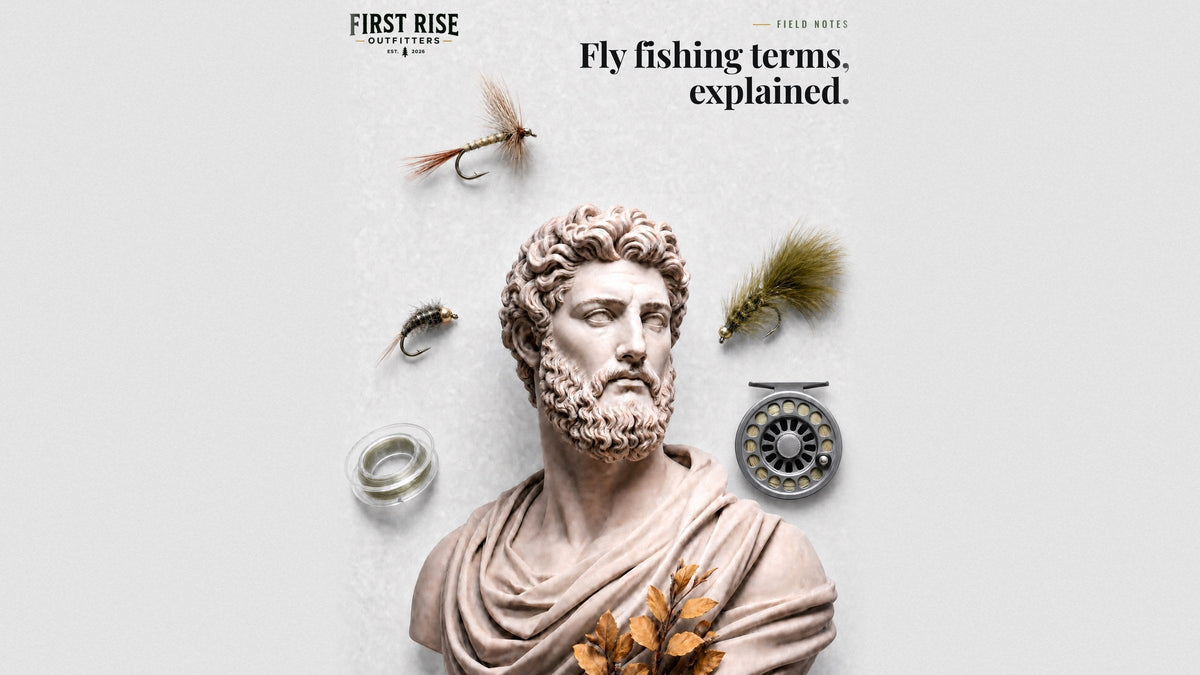
Fly fishing terms get used like everyone already knows them. Eight words cover most of what you will hear on a trout stream. Dry fly, nymph, and streamer are the three kinds of fly. Leader and tippet are the clear line between your fly line and the fly. Drag is a fly moving wrong in the current, and a mend is how you fix it. A rise is a trout eating at the surface.
About 8 million Americans fly fished in 2024, and 17% of them were doing it for the first time, according to the 2025 Special Report on Fishing from the Recreational Boating & Fishing Foundation and the Outdoor Foundation. That is well over a million people hearing "go down to 6X" for the first time. Here is what the words mean.
Key takeaways
- A dry fly floats on the surface, a nymph sinks below it, and a streamer is stripped back through the water to imitate a baitfish.
- A leader is a tapered clear line that connects the fly line to the tippet, and tippet is the thin level line the fly is tied to.
- Tippet uses the X system: subtract the X number from 11 to get the diameter in thousandths of an inch, so 5X tippet is .006 inch.
- Drag on the water is a fly moving at a different speed than the current, and a mend is the rod movement that fixes it.
- A rise is a trout breaking the surface to eat, and it is the signal to fish a dry fly.
In this article
- The three kinds of fly: dry fly, nymph, streamer
- The line: leader and tippet
- The drift: drag and mend
- What is a rise?
- FAQ
The three kinds of fly: dry fly, nymph, and streamer
What is a dry fly?
A dry fly is a fly that floats on the surface and imitates an adult insect. That can be a mayfly or caddis that just hatched, or a grasshopper or beetle that fell in from the bank. Stiff hackle and deer or elk hair keep it riding high. You watch the fish eat it, which is why the dry fly is the picture most people carry of the sport.

What is a nymph in fly fishing?
A nymph is a fly that sinks and imitates an aquatic insect in its underwater stage, before it hatches into a winged adult. Mayflies, stoneflies, and caddisflies spend most of their lives on the stream bottom in that form. A nymph imitates food that is in the river every day of the year, not only during a hatch.
How much of a trout's diet comes from underwater depends on the season. A study of a Japanese headwater stream by Kawaguchi and Nakano (Freshwater Biology, 2001) found land insects made up 68 to 77% of what the stream's salmonids, the family that includes trout and char, ate in summer and about 1% in winter. A brook trout study by researchers from the U.S. Fish and Wildlife Service and West Virginia University (Transactions of the American Fisheries Society, 2008) put land insects at 38 to 47% of what brook trout ate by weight over a full year.
You will hear that trout take 80 to 90% of their food below the surface. No study we could find backs that number. In cold months almost everything a trout eats comes from the water itself. In summer the bank can supply half.
What is a streamer?
A streamer is a larger fly that imitates a baitfish, sculpin, leech, or crayfish. You do not let a streamer drift. You cast it and strip it back in pulls so it swims. Streamers draw bigger trout, fish well in high or off-color water, and need heavier tippet.
| Dry fly | Nymph | Streamer | |
|---|---|---|---|
| Where it rides | On the surface | Below the surface, often near the bottom | Mid-water, moving |
| What it imitates | Adult insects, fallen land insects | Underwater insect larvae | Baitfish, sculpins, leeches, crayfish |
| How you fish it | Dead drift, watch the fly | Dead drift, watch the line or an indicator | Cast and strip |
| Typical trout tippet | 4X to 6X | 4X to 6X | 2X to 4X |
Tippet ranges: Orvis leader and tippet guide.

Native Waters art for the fish that eats a dry fly off the top of a mountain creek.
The line: leader and tippet
What is a leader in fly fishing?
A leader is a tapered length of clear monofilament or fluorocarbon that connects the thick fly line to the tippet. It runs thick at the butt and thin at the tip. That taper carries the energy of the cast down to the fly, so the fly turns over and lands straight instead of piling up.
Leader length follows the water. Orvis's leader length guide calls for 7.5 feet on streams 10 to 20 feet wide, 9 feet on wider riffled water, 12 feet on flat or very clear water, and 15 feet for spooky trout in extremely clear water. A 9-foot tapered leader is where most trout anglers start.
What is tippet in fly fishing?
Tippet is level line of one diameter, tied to the end of the leader, and the fly is tied to the tippet. It does two jobs. It is thin enough that a trout is less likely to notice it. And it protects the leader: every fly change cuts a few inches off, and you replace tippet from a spool instead of buying a new leader.
It is also the first thing that breaks.
Tippet is sized with the X system. Writing in Orvis News, Art Scheck lays out the Rule of 11: subtract the X number from 11 and you have the diameter in thousandths of an inch. The X tells you thickness, not strength. Two brands at the same size prove it.
| X size | Diameter (inches) | Orvis Super Strong (lb) | RIO Powerflex (lb) |
|---|---|---|---|
| 3X | .008 | 8.5 | 8.2 |
| 4X | .007 | 6 | 6.4 |
| 5X | .006 | 4.75 | 5.0 |
| 6X | .005 | 3.5 | 3.4 |
| 7X | .004 | 2.5 | 2.4 |
Sources: Orvis Tippet Chart and RIO Powerflex specifications, accessed September 2026.
Joining tippet to a leader takes one knot, and tying on the fly takes another. Both are in Essential Fly Fishing Knots Every Angler Should Know.

The drift: drag and mend
What is drag in fly fishing?
Drag has two meanings in fly fishing. You want one of them and never the other.
On the reel, drag is the adjustable brake that puts steady resistance on a running fish. On the water, drag is a fly moving faster, slower, or across the current instead of with it, because the line and leader are pulling on it. A real insect does not skate across a seam. Trout notice when your fly does.
Water drag starts when fast current between you and the fly bellies the line downstream and the belly pulls the fly along.
"A good drift is easily the most important part of presenting flies to trout."
A drift with no drag is called a dead drift. Dry flies and nymphs both depend on it.
What is mending in fly fishing?
A mend is a movement of the rod that lifts part of the fly line off the water and lays it back upstream or downstream without moving the fly. When faster current bows the line downstream, an upstream mend takes the bow out. That buys the fly a few more seconds of natural drift.
Mend early, right after the fly lands, and keep the motion small. An oversized mend drags the fly itself, which is the problem you were trying to fix. A clean mend starts with a clean cast: see How to Cast a Fly Rod Without Fighting It.


A river where every drift gets tested. Printed on a Comfort Colors 1717.
What is a rise?
A rise is a trout coming up to take food at or just under the surface. You see it as a ring, a dimple, a splash, or a nose breaking the film.
A rise tells you a fish is feeding, where it is holding, and that it is eating on top. That is the signal to tie on a dry fly.
Rising fish during a hatch are the reason people set an alarm for 4 a.m. to stand in cold water. First light. First cast. First rise.

Field guide art for the angler who wants to know what every part is called. Printed on a Bella+Canvas 3001.
Frequently asked questions
What is the difference between leader and tippet?
A leader is tapered, thick where it attaches to the fly line and thin at the far end, so the cast turns over. Tippet is level line of a single diameter tied to the end of the leader, and the fly is tied to the tippet. Leaders are bought one at a time. Tippet comes on spools, because it gets cut back every time you change flies.
What size tippet should I use for trout?
5X is the most common all-around trout tippet. Orvis recommends 4X to 6X for dry flies and nymphs and 2X to 4X for streamers. Go finer, to 6X or 7X, for small flies and wary fish in clear water. Go heavier for big flies, wind, or large fish.
When should I use a dry fly instead of a nymph?
Use a dry fly when you see trout rising or insects on the water. Use a nymph when nothing is showing on the surface, which describes most hours on most rivers. Season matters too. In winter almost everything a trout eats comes from the water itself, while in summer land insects can make up half or more of the diet.
What does mending mean in fly fishing?
Mending means repositioning the fly line on the water after the cast without moving the fly. You lift the belly of the line and flip it upstream, or sometimes downstream, so the current does not pull the fly faster than the water around it. The goal is a dead drift: a fly that moves exactly like something the current is carrying.
What is a rise in fly fishing?
A rise is a trout coming to the surface to eat. It shows as a ring, a dimple, or a splash on the water. A rise means a fish is feeding, shows you where it is holding, and tells you it is taking food at or near the top. That makes it the clearest signal to switch to a dry fly.
One more cast.
Brook, brown, rainbow, and cutthroat, drawn like the plates in an old field guide.
Shop the CollectionSources
- Recreational Boating & Fishing Foundation and Outdoor Foundation, 2025 Special Report on Fishing (2024 data), pages 20 to 21
- Kawaguchi, Y. and Nakano, S., "Contribution of terrestrial invertebrates to the annual resource budget for salmonids in forest and grassland reaches of a headwater stream," Freshwater Biology 46:303-316, 2001
- Sweka, J.A. and Hartman, K.J., Transactions of the American Fisheries Society 137:224-235, 2008
- Scheck, A., "Pro Tips: A Simple Approach to Leaders," Orvis News
- Orvis Learning Center, Tippet Chart and How to Choose the Right Leader Length
- RIO Products, Powerflex Tippet specifications
- Orvis, What Is Drag and Why Is It Bad?