
Fishing in National Parks: Permits, Rules, and What Changes Park to Park
By Bobby Harris — Navy FMF Corpsman (2002–2010), founder of First Rise Outfitters
There is no single rule for fishing in a national park. Each park sets its own, and the differences are large enough to end a trip before it starts. Yellowstone sells its own permit and does not accept state fishing licenses at all. Glacier requires no license of any kind inside park boundaries. Great Smoky Mountains runs entirely on Tennessee and North Carolina state licenses, which it does not sell. Rocky Mountain needs a Colorado license plus a habitat stamp. Four parks, four completely different answers. Check the specific park before you pack a rod.
Key takeaways
- Yellowstone National Park requires its own park fishing permit, and state fishing licenses are not valid there.
- Glacier National Park requires no fishing license at all inside park boundaries.
- Great Smoky Mountains requires a Tennessee or North Carolina license, and does not sell licenses inside the park.
- Rocky Mountain National Park requires a Colorado license plus a $10 Habitat Stamp for most adults.
- Tribal waters inside park boundaries can be governed by tribal authorities rather than the park or the state.
In this article
- Is there one fishing rule for all national parks?
- Yellowstone: its own permit, no state license
- Great Smoky Mountains: two states, no park sales
- Glacier: no license required
- Rocky Mountain: Colorado license plus habitat stamp
- At a glance
- What else changes besides the permit
- FAQ
Is there one fishing rule for all national parks?
There is no single national park fishing rule. The National Park Service sets fishing regulations park by park, and a park can require its own permit, defer entirely to the surrounding state, or require nothing at all. Assuming your state license travels with you is the most common and most expensive mistake an angler makes on a park trip.
The reason for the variation is that park fisheries face different problems. A park protecting a native cutthroat population manages differently from a park whose water is continuous with a heavily stocked state river. Yellowstone says plainly that its fishing regulations "are structured to strongly support native fish conservation goals."
Fishing in parks is also less common than you would guess. Yellowstone reports that about 50,000 of the park's four million annual visitors fish each year, which is roughly one in eighty.
Yellowstone: its own permit, and no state license
Yellowstone National Park requires a park-specific fishing permit and does not recognize state licenses. The NPS states it directly: "Anglers 16 years of age or older must be in possession of a valid Yellowstone National Park fishing permit to fish in the park. State fishing licenses are not valid and aren't required."
This catches people out. Yellowstone spans Wyoming, Montana, and Idaho, and a Montana license bought that morning will not cover you once you cross the boundary. It is not that the state license is insufficient. It is not valid at all.
Permit pricing as published by the park:
- Three-day permit: $40
- Seven-day permit: $55
- Season-long permit: $75
Permits are sold online through Recreation.gov. Park rangers may check permits and inspect tackle, fish, creels, or other containers where fish or tackle may be stored.
One more Yellowstone-specific requirement worth planning around: all watercraft, including angler float tubes and paddle boards, must pass a Yellowstone aquatic invasive species inspection to receive a permit before launching.

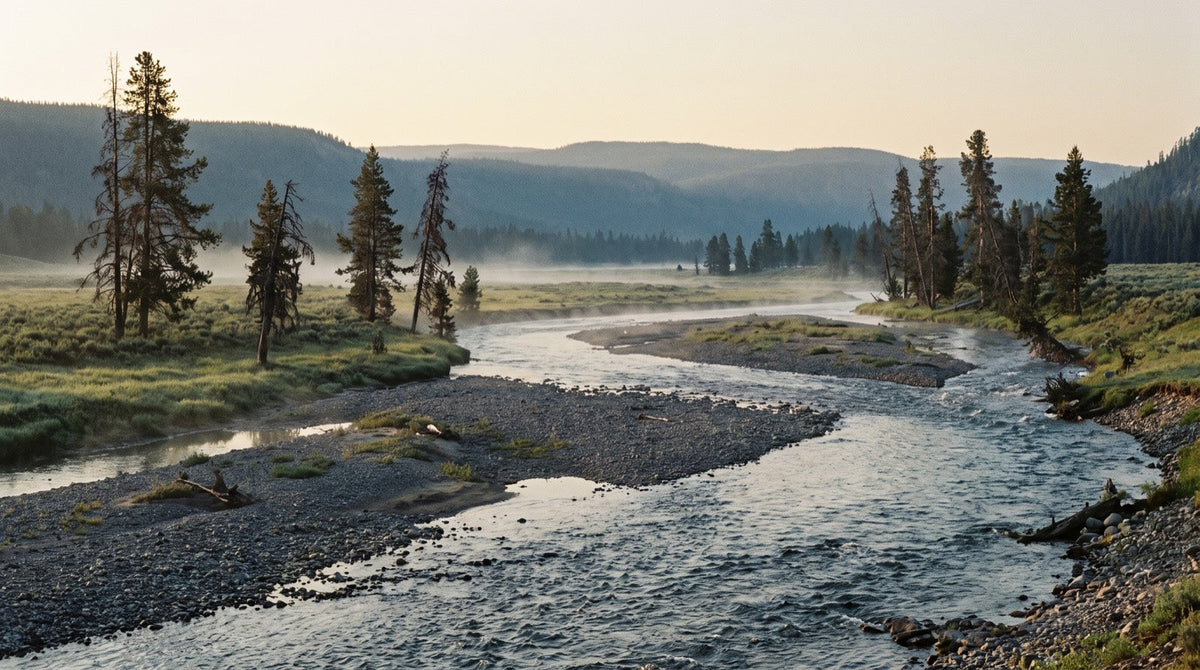
Drawn from the river that runs the length of the park, and the native cutthroat those regulations exist to protect.
Great Smoky Mountains: two states, and nothing sold in the park
Great Smoky Mountains National Park requires a state license from either of the two states it straddles. Per the NPS: "Residents and nonresidents 16 years of age and older must possess a valid fishing license or permit from either Tennessee or North Carolina." Either state's license is valid throughout the park, which is unusual and genuinely convenient.
The trap is procurement. "Fishing licenses and permits are not sold in the park." You buy them in surrounding towns or online, before you arrive. There is no ranger station where you can fix this at 7 a.m. on the first morning.
Two additional permits exist inside the boundary. The NPS notes that special permits are required for fishing in Gatlinburg and in Cherokee, which are separately managed waters rather than standard park stream.
Note also that Tennessee's own license threshold is lower than the park's. Tennessee requires a license from age 13, while the park's requirement starts at 16.


The most visited park in the country, and some of the best small-stream water in the East.
Glacier: no license required at all
Glacier National Park requires no fishing license inside park boundaries. The NPS states it in four words: "No fishing license is required to fish inside park boundaries." That is the simplest permit answer of any major park, and it surprises most anglers who hear it.
No license does not mean no rules. Glacier sets its own seasons, catch limits, and possession limits, and fishing is permitted only "when consistent with preservation or restoration of natural aquatic environments." The regulations are the constraint, not the paperwork.
Two boundary cases matter. On the North Fork of the Flathead River, catch and possession limits, seasons, and methods of take match those set by the State of Montana, but no state license is required when you are fishing the North Fork from park lands. And Lower Two Medicine Lake is governed differently again: its season and its catch and possession limits are set by the Blackfeet Nation, not the park or the state.
Waters along the Canadian boundary carry their own requirement. Check Canadian regulations before fishing them.
Rocky Mountain: a Colorado license plus a habitat stamp
Rocky Mountain National Park defers entirely to Colorado. Per the NPS, "A valid Colorado fishing license is required for all persons 16 years of age or older to fish in Rocky Mountain National Park," and "No other permit is necessary; however, special regulations exist."
The detail that catches people is the habitat stamp. Individuals over 18 and under 65 are required to purchase a $10 Habitat Stamp with their first license purchase of the year. Buyers of one-day or additional-day licenses are exempt for the first two such licenses, with the fee assessed on the third.
Licenses are sold by agents throughout Colorado, online, or by phone. As in every park on this list, the license gets you legal and the special regulations govern where and how you actually fish.
National park fishing permits at a glance
| Park | What you need | Age threshold | Cost |
|---|---|---|---|
| Yellowstone | Park permit only. State licenses not valid | 16+ | $40 / 3 days, $55 / 7 days, $75 / season |
| Great Smoky Mountains | Tennessee or North Carolina license. Not sold in park | 16+ | State rates |
| Glacier | No license required inside park boundaries | None | Free |
| Rocky Mountain | Colorado license, plus Habitat Stamp for most adults | 16+ | State rates plus $10 stamp |
Requirements as published by the National Park Service for each park. Fees and rules change, so confirm on the park's own page before your trip.
What else changes besides the permit
The permit is the first difference between parks, not the only one. Once you are legal, the park-specific regulations decide where and how you can actually fish, and those vary more than the licensing does.
Expect variation in season dates, catch and possession limits, tackle restrictions, and which specific waters are open. Yellowstone notes that exceptions are listed within each of its regional regulations, so a rule that holds on one drainage may not hold on the next one over. Streams there may also be closed temporarily due to low water levels and high water temperatures to protect fish populations, which means a water that was open last week can be shut this week.
Tribal jurisdiction is the case most anglers never consider. Lower Two Medicine Lake sits inside Glacier, but its season and limits are set by the Blackfeet Nation. Being inside a park boundary does not tell you who writes the rules for that particular water.
Bear country adds a safety layer to the legal one. Yellowstone advises anglers to carry bear spray and know how to use it, to avoid fishing alone, and to try to stay in a group of three or more.
Our catch and release guide covers handling once you are on the water, and the trout conservation guide covers why native-water rules are usually the strictest.

For the water that belongs to everyone, and the rules that keep it worth fishing.
Frequently asked questions
Do you need a fishing license in a national park?
It depends entirely on the park. Rocky Mountain National Park requires a valid state license from Colorado. Great Smoky Mountains requires one from Tennessee or North Carolina. Glacier requires no fishing license at all inside park boundaries. Yellowstone requires its own park permit and does not accept state licenses. There is no single national park rule, so check the specific park before you go.
Does a state fishing license work in Yellowstone?
No. The National Park Service states that anglers 16 years of age or older must hold a valid Yellowstone National Park fishing permit, and that state fishing licenses are not valid and are not required. Yellowstone spans Wyoming, Montana, and Idaho, but none of those state licenses will cover you inside the park boundary.
How much does a Yellowstone fishing permit cost?
The park publishes three options: a three-day permit for $40, a seven-day permit for $55, and a season-long permit for $75. Permits are available to purchase online through Recreation.gov. Park rangers may check permits and inspect tackle, fish, creels, or other containers where fish or tackle may be stored.
Can you fish in Great Smoky Mountains National Park without a license?
No. Residents and nonresidents 16 years of age and older must possess a valid fishing license or permit from either Tennessee or North Carolina, and either state's license is valid throughout the park. Licenses are not sold inside the park, so buy one online or in a surrounding town before you arrive. Special permits are required for Gatlinburg and Cherokee.
Who sets the fishing rules on tribal waters inside a national park?
The tribe does, not the park or the state. Lower Two Medicine Lake sits within Glacier National Park, but its season and its catch and possession limits are set by the Blackfeet Nation. Being inside a park boundary does not tell you which authority writes the rules for a particular water, so confirm before fishing.
Sources
- Fishing, Yellowstone National Park, National Park Service
- Fishing, Great Smoky Mountains National Park, National Park Service
- Fishing, Glacier National Park, National Park Service
- Fishing, Rocky Mountain National Park, National Park Service
The Rivers You Fish. The Species You Chase.
Field-guide inspired apparel celebrating native trout, wild rivers, and the places worth getting up before daylight for.
Shop the Collection →Free shipping on orders over $75.