
Brook vs Brown Trout: A Field Guide for Anglers
By Bobby Harris — Navy FMF Corpsman (2002–2010), founder of First Rise Outfitters
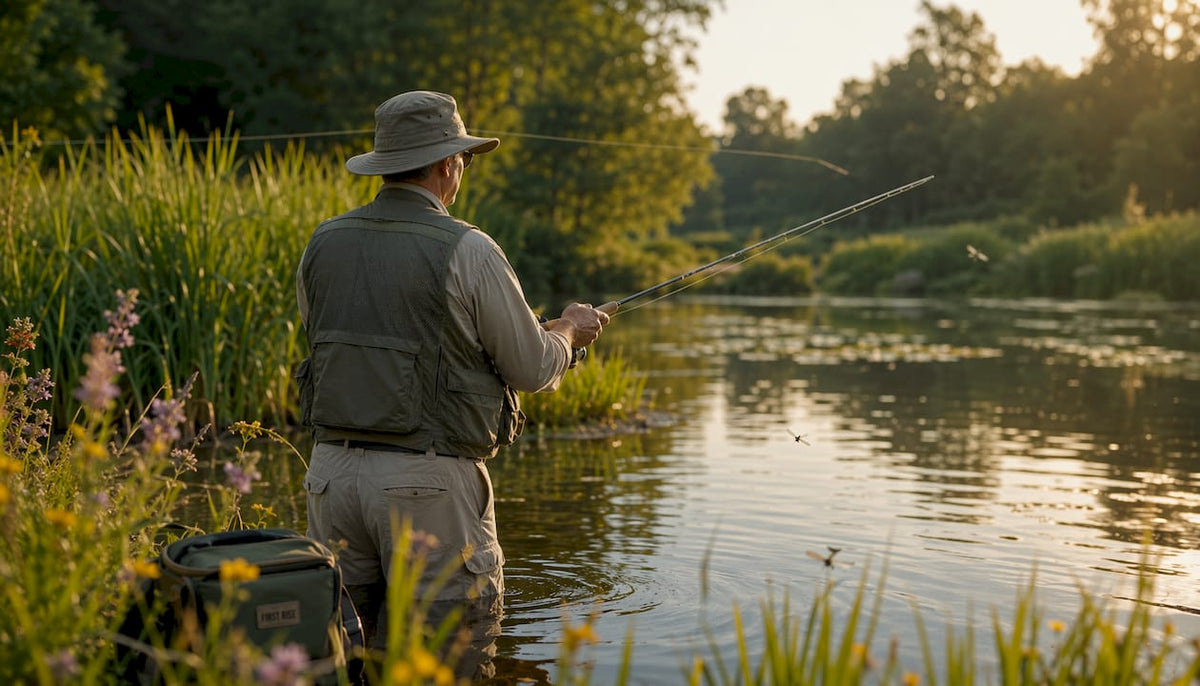
Brook trout are the cold-water native char of eastern headwaters, blazing with red spots and white-edged fins. Brown trout are the larger, golden-flanked European import that holds tight to structure in bigger water. Choose brook trout for a visual, fast-paced morning in cold pocket water. Choose brown trout when you want a tactical, cover-oriented challenge with a shot at a bigger fish.
| Feature | Brook Trout | Brown Trout |
|---|---|---|
| Visual ID | Red spots with blue halos, white fin edges, vermiculation on back | Dark spots on golden body, spots on adipose fin, plain lower fins |
| Preferred habitat | Cold headwaters, beaver ponds, high lakes | Larger rivers, spring creeks, tailwaters, deep pools |
| Temperature tolerance | Survival limit in colder range | Optimal in moderate cold to cool range; tolerates moderately warmer water |
| Behavior | Opportunistic, visual, daytime feeder | Wary, structure-oriented, crepuscular/nocturnal |
| Best tactics | Dry flies, small nymphs, tight pocket-water drifts | Dead-drift nymphs, streamers, low-light presentations |
| Conservation note | Native; protected in many headwaters | Introduced; can displace brook trout |
| Typical size | generally small in streams; can grow larger in remote lakes | typically larger; trophies found in tailwaters |
Quick call to action for today:
- Water temp above 65°F? Skip both and rest the fish.
- Cold, clear headwater stream? Target brook trout with a dry fly at first light.
- Big river with undercut banks? Work streamers for brown trout at dusk.
Table of Contents
- How do you tell brook and brown trout apart in the field?
- Where do you find each species, and how warm is too warm?
- How do behavioral differences shape your angling approach?
- Why do brown trout push brook trout out, and what can you do about it?
- When should you stop fishing, and how do you handle fish safely?
- What gear and fly setups work best for each species?
- Which trout should you target today?
- Key Takeaways
- Frequently asked questions
- The trout you choose says something about the morning you want
- Wear the fish you fish for
- Useful sources
How do you tell brook and brown trout apart in the field?
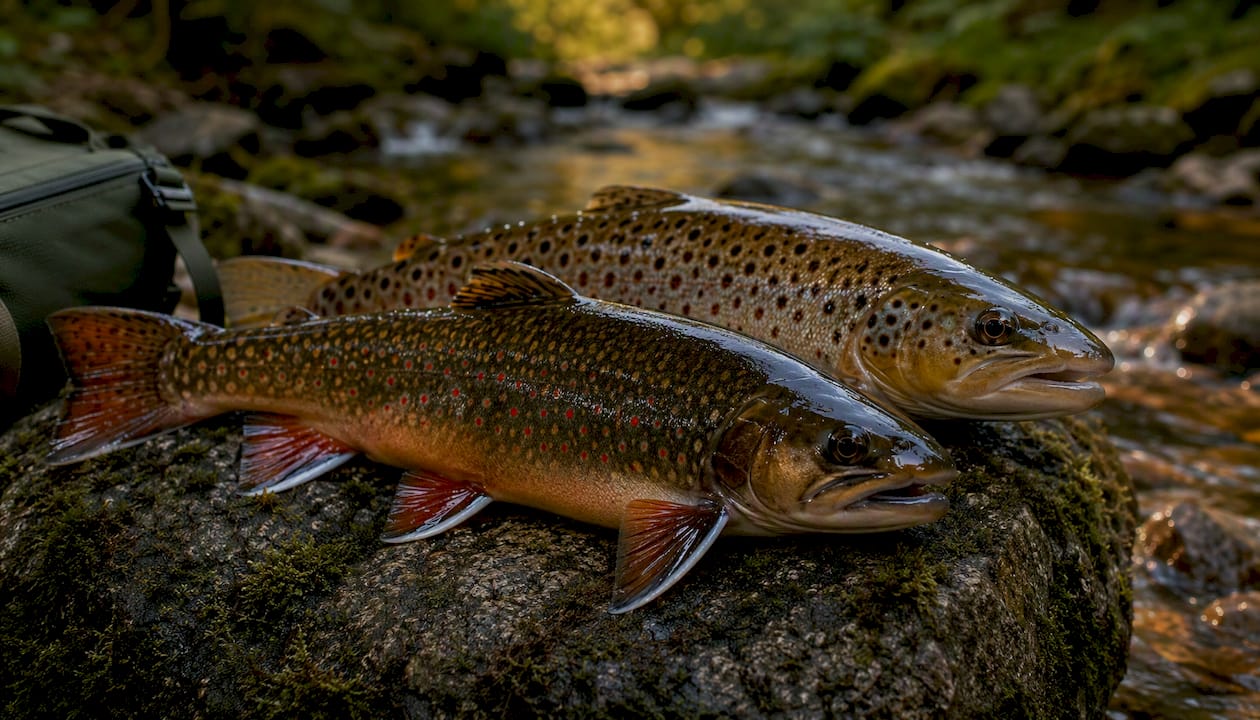
The single most reliable check is the lower fin edge. Brook trout have a crisp white leading edge on the pectoral, pelvic, and anal fins, backed by a thin black stripe and then a vivid reddish-orange color. Brown trout lower fins are plain, ranging from pale yellow to dull orange with no white margin at all.
Fast field checks:
- White fin edge: Present on brook trout, absent on brown trout. This cue holds even in stained water.
- Spot pattern: Brook trout show light spots (including red spots with blue halos) on a darker body. Brown trout show dark spots on a lighter golden body, often with a few red or orange spots encircled by a pale halo.
- Vermiculation: The worm-like maze pattern on the back and dorsal fin is unique to brook trout. If you see it, you have a brookie.
- Adipose fin: Brown trout frequently have spots on the adipose fin; brook trout typically do not.
- Tail shape: Brook trout tails are nearly square. Brown trout tails are slightly forked.
Photo ID tip: When light is low or water is tannin-stained, photograph the pectoral fin flat against your wet hand. The white edge on a brook trout is unmistakable even in a dark photo. Color alone can mislead you — a brookie in dark water can look almost as golden as a brown, and a limestone-creek brown can appear silver.
Pro Tip: Trophy brook trout in remote high-elevation lakes can grow surprisingly large and get mistaken for browns by size alone. Always check the tail shape and fin edges before making any ID-based handling decision.
Where do you find each species, and how warm is too warm?
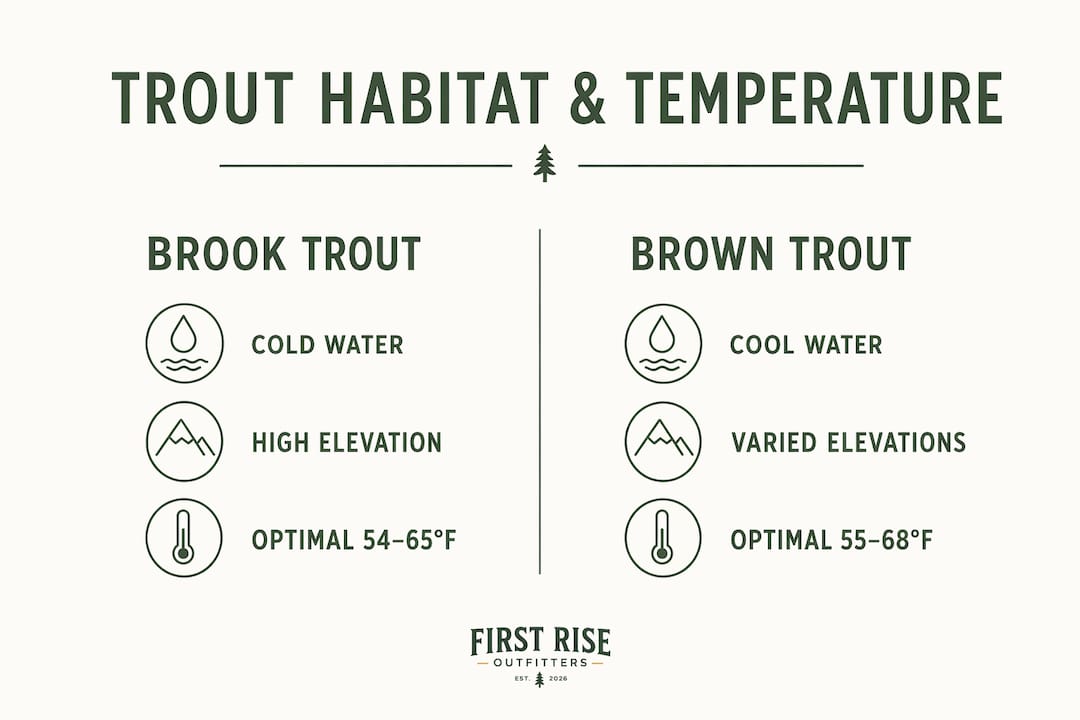
Brook trout occupy the coldest, highest water in a watershed: headwater streams, beaver ponds, and glacial lakes where temperatures rarely climb above 60°F. Brown trout push into larger freestone rivers, spring creeks, tailwaters, and the deeper pools where structure concentrates prey.
| Species | Preferred waters | Optimal feeding temp | Conservative angling threshold |
|---|---|---|---|
| Brook trout | Headwaters, beaver ponds, high lakes | 60°F | Stop fishing above 65°F |
| Brown trout | Large rivers, spring creeks, tailwaters | 60°F–65°F | Reduce pressure above 66°F |
Brown trout are optimally active between 60°F and 65°F, and can survive in water up to about 75°F (24°C), although activity and feeding decrease as temperatures rise.
Brook trout are cold-water specialists with limited tolerance for warmer water temperatures. Brown trout are more adaptable, feeding well in cool to moderate temperatures and tolerating warmer waters better, though their activity decreases as temperatures rise.
Critical threshold: Brook trout cannot survive extended exposure above 68°F (20°C). On a hot July afternoon, even a short fight and a quick photo can push a stressed fish past recovery.
How do behavioral differences shape your angling approach?
Brook trout are opportunistic and visual. They hold in the shallowest, coldest pocket water and right under banks, and they will rise to a dry fly with little hesitation on a good morning. Brown trout are a different puzzle entirely. They are wary, structure-oriented, and often feed crepuscularly or nocturnally, demanding precise presentations and a patient read of the water.
Fly and lure picks by species:
Brook trout:
- Elk Hair Caddis or Parachute Adams (#14–#18) on small mountain streams
- Soft-hackle wet flies swung through cold runs
- Small bead-head nymphs (Hare’s Ear, Pheasant Tail) under an indicator
Brown trout:
- Dead-drift nymphs and streamers targeting undercut banks and log jams
- Woolly Bugger or Muddler Minnow stripped slowly at dusk
- Larger dry flies (Stimulator, Chubby Chernobyl) during heavy hatches
Pro Tip: For brown trout, don’t just cast to the seam — cast to the immediate edge of structure where the current slows. Browns ambush from the energy break, not from the middle of the current. A fly that drifts six inches too far into fast water will be ignored.
Why do brown trout push brook trout out, and what can you do about it?
Brown trout are a European introduction that can out-compete and prey on native brook trout. Trout Unlimited has documented how brown trout introductions have altered many watersheds, pushing brook trout into ever-smaller, colder headwater refuges where the thermals are too harsh for browns to follow. State agencies now prioritize protecting wild brook-trout watersheds precisely because of this dynamic.
The mechanism is straightforward: brown trout tolerate warmer water, grow larger faster, and actively prey on smaller brook trout. As a river warms even slightly, the competitive edge shifts further toward browns.
What you can do:
- Avoid wading through cold headwater seeps and spring areas in brook-trout-only streams.
- Follow all catch-and-release and slot-limit rules for designated native brook-trout waters.
- Report unusual catches (especially large brown trout in historically brook-trout-only headwaters) to your state fish-and-game agency.
- Check state agency guidance before fishing any labeled “wild trout” or “native trout” water.
Firstriseoutfitters carries conservation messaging on its Trout Heritage collection — a small way to carry that stewardship mindset off the water too.
When should you stop fishing, and how do you handle fish safely?
The short answer: stop targeting brook trout when water temps hit 65°F, and ease off brown trout above 66°F. Both thresholds are conservative on purpose. A fish that survives the fight can still die hours later from thermal stress.
Catch-and-release checklist:
- Wet your hands and net before touching the fish.
- Keep the fish in the water as much as possible; limit air exposure to under 15 seconds.
- Avoid fishing during the hottest part of the day in summer (roughly 1–5 PM).
- Revive the fish in a gentle current, holding it upright until it kicks free on its own.
- Check your state’s current regulations before heading out — MassWildlife and the PA Fish & Boat Commission both publish temperature advisories and seasonal closures.
Brook trout spawn in fall (October–November in most of the East). Brown trout also spawn in fall, typically November–December. Give both species a wide berth on their redds, and check local rules for seasonal closures on spawning streams.
Safe handling threshold: Keep brook trout in the water above 65°F. At that temperature, even a brief fight raises their core temperature enough to cause delayed mortality.
What gear and fly setups work best for each species?
Brook trout in small headwaters: A 7–8 ft, 3-weight rod is the sweet spot for tight, tree-lined streams. Pair it with a weight-forward floating line, a 7.5 ft leader tapered to 5X, and a short tippet. For beginner fly-fishing setups, a simple dry-dropper rig (Elk Hair Caddis on top, small Hare’s Ear below) covers most small-stream situations.
Brown trout on spring creeks and tailwaters: Step up to a 9 ft, 5-weight rod with a longer, finer leader (12 ft tapered to 6X). Presentation matters more than fly selection. A Zebra Midge, RS2, or small Pheasant Tail nymph dead-drifted through a seam will outfish a flashy pattern thrown carelessly.
Quick gear list to pack:
- Thermometer (non-negotiable for temperature checks)
- Forceps for quick, in-water hook removal
- Rubber-mesh net to protect slime coat
- Polarized sunglasses for reading lies and spotting fish
- A wilderness fly-fishing guide bookmarked for headwater trip planning
Rig recipe 1 — Brook trout dries/nymphs:
- 7.5 ft 5X leader
- Elk Hair Caddis #16 as the dry
- 10-inch dropper to a Zebra Midge or Hare’s Ear #18
Rig recipe 2 — Brown trout streamers:
- 9 ft 4X leader
- Woolly Bugger #8 (olive or black) as the lead fly
- Optional: 18-inch dropper to a small soft-hackle for a two-fly swing at dusk
Which trout should you target today?
If you want numbers, scenery, and a relaxed morning, go brook trout. If you want a challenge and a shot at a bigger fish, go brown trout.
Scenario guide:
- Short day hike to a headwater stream: Brook trout, dry fly, early morning.
- Family trip with kids: Brook trout in a stocked or accessible stream — they bite more readily.
- Night fishing a big river: Brown trout, streamer, focus on undercut banks.
- Trophy pursuit on a tailwater: Brown trout, technical nymph rig, low-light windows.
- Conservation-first outing: Brook trout in a designated native stream, strict catch-and-release.
If you start the day chasing brookies in the headwaters and temps climb by noon, shift downstream to a deeper pool and switch to brown-trout tactics. That mid-trip pivot protects the fish and keeps you productive.
Key Takeaways
Brook trout and brown trout require different water, different tactics, and different handling care — knowing which is which before you rig up saves time and protects the fish.
| Point | Details |
|---|---|
| Reliable field ID | Check the lower fin edge: white on brook trout, plain on brown trout — works even in stained water. |
| Temperature limits | Stop fishing brook trout above 65°F; their survival limit is approximately 68°F (20°C). |
| Habitat split | Brook trout hold in cold headwaters and beaver ponds; brown trout favor larger rivers and deep structure. |
| Conservation priority | Brown trout are an introduced species that can displace native brook trout; follow local stewardship rules. |
| Firstriseoutfitters | The Trout Heritage collection carries species-specific artwork for anglers who want to wear their conservation values. |
Frequently asked questions
Are brook trout actually trout?
No. The U.S. Fish and Wildlife Service classifies brook trout as members of the char family, genus Salvelinus. Brown trout are true trout, genus Salmo. The two are not closely related despite sharing water and a common name. This is why brook trout show light spots on a dark body while brown trout show dark spots on a light one.
Are brown trout native to the United States?
No. According to the USGS Nonindigenous Aquatic Species database, brown trout were first imported to the United States in 1883 from Germany and stocked in the Pere Marquette River, Michigan, by the U.S. Fish Commission. The species has since been stocked in virtually every state. Brook trout are the native fish in eastern headwaters.
Which is easier to catch, brook trout or brown trout?
Brook trout. The USGS notes that brook trout are more susceptible to angling and predation than brown trout. Brook trout feed opportunistically and in daylight, while brown trout are wary, hold to structure, and often feed at dawn, dusk, or after dark. That difference in caution is the main reason brown trout are the harder fish.
How long do brown trout live?
Brown trout usually live 5 to 6 years, according to the USGS. Individuals that switch to a primarily fish-based diet can reach around 12 years. That dietary shift is also what produces the large trophy browns found in tailwaters, since eating other fish supports far more growth than eating insects.
Are there sea-run brown trout?
Yes. The USGS reports that some brown trout from freshwater tributaries migrate to the ocean to feed in estuaries and coastal waters, then return to fresh water to spawn. These fish are called sea trout and typically take on a silver coloration. It is the same life-history split that separates steelhead from resident rainbow trout.
The trout you choose says something about the morning you want
There’s a real difference between a brook-trout morning and a brown-trout evening, and it goes beyond the fish. Choosing a brookie day means committing to cold water, early light, and the kind of fishing where a six-inch fish on a dry fly feels like a win. Choosing a brown-trout evening means patience, structure, and the quiet satisfaction of fooling a fish that has seen every fly in the box.
At Firstriseoutfitters, that distinction is baked into the brand. The hand-drawn artwork on each species tee isn’t just decoration — it’s a nod to the specific water, the specific morning, and the specific fish that made the day. Bobby, who runs First Rise, built the line around the idea that the best fishing days start before most people are awake, and that the fish you target shapes the whole experience.
Whether you’re a brookie purist or a brown-trout obsessive, the stewardship part is the same: check temps, handle fish gently, and leave the water better than you found it.
Wear the fish you fish for
After a good brook-trout morning or a hard-earned brown-trout evening, there’s something satisfying about wearing the fish on your back. Firstriseoutfitters makes garment-dyed tees printed on Comfort Colors blanks with hand-designed trout artwork in muted, river-inspired tones. No loud logos, no synthetic performance fabric — just a well-made shirt that looks right on a tailgate at 5 AM or at the fly shop counter.
The Brook Trout Fishing T-Shirt from the Native Waters line is the go-to for headwater anglers who take their brookies seriously. For a broader look at the full species lineup, the Trout Heritage collection covers brook, brown, rainbow, and cutthroat in the same hand-drawn style. They also make a solid gift for the angler in your life who already has every piece of gear they need.
Browse the full collection at firstriseoutfitters.com and find the tee that matches your water.
Useful sources
- Trout Identification and Fishing Tips — MassWildlife / Mass.gov
- Trout ID Field Guide — PA Fish & Boat Commission (PDF)
- Brook Trout, Brown Trout, and Why They Rarely Coexist — Trout Unlimited
- Brook Trout (Salvelinus fontinalis) — U.S. Fish & Wildlife Service
- Brown Trout (Salmo trutta) Species Profile — USGS Nonindigenous Aquatic Species
- Brook Trout vs Brown Trout: Key Differences & Guide — Cast & Fly
- Brook Trout vs Brown Trout: How to Tell Them Apart — Sierra Fly Fisher
- Brook vs Brown Trout Comparison — FishDatabase
Always check your state fish-and-game agency’s current regulations for size limits, seasonal closures, and temperature advisories before planning a trip. Rules vary by water and change seasonally.
Recommended
- Steelhead vs. Rainbow Trout: 5 Differences You Can Actually See on the Water – First Rise Outfitters
- Brook Trout Fishing T-Shirt | Vintage Native Waters Angler Tee – First Rise Outfitters
- Trout Fishing Tips for Beginners: Your First Catch Guide – First Rise Outfitters
- How to Fly Fish: A Complete Beginner’s Guide – First Rise Outfitters